
The European Animal Rights Law Conference 2021

On 17 and 18 September 2021, I attended the European Animal Rights Law Conference 2021 in Cambridge, United Kingdom. This was the second such conference to be hosted by the Cambridge Centre for Animal Rights Law. It brought together legal academics and practitioners from around Europe and beyond to discuss their latest research. For an explanation of what falls within the scope of animal rights law, as opposed to animal welfare law, please see my previous blog post.  

The programme for the conference can be found here and recordings of all the presentations will shortly be made available to watch online. This post does not provide an exhaustive account of the conference. It aims to whet the appetite, and to give an idea of the range of ideas circulating in the animal rights law community.

Raffael Fasel, executive director of the Cambridge Centre for Animal Rights Law, introduced the conference. As is impossible to resist, Dr Fasel drew a parallel between the work of the Centre and our common experiences in the last eighteen months, saying that animal rights are inseparable from human health, but that animal interests are generally only taken seriously when human interests are also at stake. The aim of work in this field is both to clarify such connections and make the case for the importance of animal rights for their own sake. 

Animals as agents, animals as knowers, animals as activists?

Angie Pepper and Richard Healey made the first substantive presentation. It was not legal, but philosophical. Drs Healey and Pepper developed the concepts of assent and dissent to address the problem of reconciling human-animal relationships with animals’ right to self-determination. The presentation was extremely clear and came in two parts. First, Dr Healey summarised the paper they had published together earlier this year, entitled ‘Interspecies justice: agency, self-determination, and assent’. Second, Dr Pepper explained their doubts about the conclusions in the paper.

The paper states that animals have a right to self-determination in a certain context, which is to say that their will is authoritative in that context, when two conditions are met. The conditions are, first, that the animal has sufficient interest in self-determination to ground duties in others, and, second, that the animal is a sufficiently competent decision-maker in the relevant context. Animals’ interest in self-determination itself derives from their agential capacities. When an animal (human or not) has a right to self-determination in a certain context, their will is structurally decisive in that context, which is to say that their will has normative authority in that context. To illustrate, a crow has a right not to have their body interfered with, and this right excludes all other reasons for interfering with the crow’s body. In other words, their right is absolute.

Humans use consent to navigate their self-determination. This means that they understand their right to self-determination and its correlative duties and are capable of intending to waive that right. For example, I understand that I have a right to non-interference with my body, but I waive that right when I consent to being hugged. But most animals cannot understand their right to self-determination on a normative level. This means that they cannot consent to waiving that right. As a result, it appears that it would be morally impermissible for humans to interfere with an animal’s right to self-determination by, for example, stroking, cuddling or bathing an animal.

To solve this problem, the paper develops the concepts of assent and dissent, which are, respectively, the wilful affirmation of, and the wilful refusal to engage in, an interaction. Assent and dissent may be active or passive but must be voluntary and based upon understanding of the interaction in question. In this way, the paper proposes that an animal can assent to an interaction with a human being without having the normative understanding to consent to it, making permissible certain human-animal interactions. A dog may not normatively consent to being cuddled, but they can assent to being cuddled by voluntarily affirming the cuddle in an active or passive way.

Dr Pepper explained that the inspiration for the paper was a stray cat who had adopted her and Dr Healey. The paper implicitly focussed on the question whether interactions within a companion animal relationship could be permissible. What it failed to tackle was the question whether the broader project or relationship within which such interactions took place could itself be permissible. On reflection, it appeared that the answer was no. Valid assent to specific interpersonal interactions cannot legitimise the relationships and institutions in which animals find themselves. This is because, in order to assent to something, an animal requires sufficient information about it and understanding of it, which as an empirical matter they cannot have in the cases of relationships and institutions. For example, an animal cannot consent to being a pet because they cannot, at the onset of the relationship or at any other stage, understand what is at stake, and their assent to specific interactions cannot be aggregated to form assent to a relationship or a status. Further, in the absence of any meaningful opportunity to leave the relationship, they cannot dissent from it. In order to be at all justifiable, a companion animal relationship would have to provide a pet with the opportunity to leave at any moment. The presentation concluded on this doubtful note.

Eva Meijer gave a wide-ranging presentation on the theme of animal agency and animals as knowers. Like the one before, it asked, rather than answered, questions. Dr Meijer’s starting-point was a new law passed by the Dutch legislature earlier this year that will significantly improve the welfare of farmed animals when it comes into force in 2023. Among other things, it may end factory farming in the Netherlands. Dr Meijer proposed that laws such as this move the conversation on from animal welfare to animal flourishing. And the question of animal flourishing is both species-specific and individual-specific. It cannot be easily measured from the outside. If we are going to take animal sentience seriously and go beyond anti-cruelty laws, we must grapple with the fact that animals are knowers, of the world and of their own lives; that animals are subject to epistemic injustice when we deny them this status; and that our knowledge of them is distorted by anthropocentrism, which is to say by our own interests in observing animals. Not only this, but the means of acquiring knowledge about animals generally violate their dignity in one way or another. So we are caught in a situation where we do not know enough about animals’ subjectivity to properly legislate for their flourishing, but we are both morally and epistemically constrained from understanding the circumstances under which they would flourish. 

Alasdair Cochrane gave the keynote address. He described it as more of a call to arms than a tight argument. The subject was interspecies solidarity, and there were two questions. Why should we think about solidarity in an interspecies context? And can solidarity cross a species barrier?

The context of the talk was Dr Cochrane’s work on the animal turn in political philosophy, or the political turn in animal ethics. The political-animal turn, from whatever perspective, is broadly based on the premise that benign human-animal relations require not only personal but also political and legal transformation. Changing hearts and minds is not enough, because political and legal institutional barriers prevent animals from leading good lives. Works such as Zoopolis by Sue Donaldson and Will Kymlicka, and Dr Cochrane’s own book Should animals have political rights?, set out visions of just worlds. Less effort has been expended asking how we achieve, and sustain, those visions. These, according to Dr Cochrane, are “very very very very very very very” tough questions. But he proposes that solidarity plays an important role. This is because it has played an important role in other social justice movements, in three ways: as a bond to create and maintain a political community; as a shared commitment to unite activists; and as an institutional framework to cement support of the vulnerable. In short, solidarity is a bridge between compassion and political or legal change.

Turning to the question whether solidarity with animals is possible, Dr Cochrane adopted the three forms of solidarity identified by Sally Scholz. These track the three purposes of solidarity. They are social, political, and civic solidarity. Humans can share social solidarity with animals: pets and police dogs are recognised as part of our communities. Even though not all animals are currently seen this way, it is in principle possible. Humans can share civic solidarity with animals: there exist institutional apparatuses for the protection of vulnerable animals, such as shelters, vaccinations for endangered animals, and police dog pensions. These examples may apply to a tiny proportion of animals, but they show that, in principle, civic solidarity can cross the species barrier. Can humans share political solidarity with animals? This is not clear, but it seems not. Political solidarity requires a unifying commitment to political action, which animals cannot share with humans because they cannot understand political action. Some might see animals’ deliberate resistance to oppression as commitment to the political fight against oppression. Dr Cochrane is doubtful. But even if we can only share social and civic solidarity with animals, we can have political solidarity with each other as humans on behalf of animals, which serves the same purpose. 

Animals in constitutions

We moved from the political to the legal. John Adenitire presented his forthcoming paper, which argues for a conception of the rule of law that takes seriously the sentience of animals other than humans. The paper forms part of an ongoing research project conducted by Drs Adenitire and Fasel on animal rights and constitutionalism. The top-line contention is that constitutional principles that focus only on humans at the expense of all other animals (and also at the expense of humans who lack certain privileged traits) lack justification. New, more justifiable principles must be forged. The rule of law is just one aspect of constitutional theory that must be reshaped to accommodate animals.

The (or a) dominant account of the rule of law is that it facilitates the guidance of human conduct by the law. On this account, the rule of law does not protect those who cannot fit their conduct to the guidance of the law. Such individuals are passive legal subjects, who are to be contrasted with active legal subjects, who are capable of understanding and adjusting their conduct to fit the law. Animals are passive legal subjects, as are some humans, such as infants and severely mentally disabled individuals. The rule of law as generally conceived only accounts for active legal subjects. If the rule of law is to protect not only animals but also the humans who are passive legal subjects, it requires a different rationale. Dr Adenitire proposes that a more inclusive account of the rule of law is that it restrains arbitrary power. Anyone, whether capable of understanding the law or not, can be protected by the restraint of arbitrary power. This conception of the rule of law is preferable and should be promoted.

Dr Adenitire substantiated this central argument with reference to three representative theories of the rule of law: Lon Fuller’s formal theory, Jeremy Waldron’s procedural theory, and T. R. S. Allan’s substantive theory. Each of these theories of the rule of law has a different thickness, but each is addressed exclusively to active legal subjects. Dr Adenitire does not commit to a thicker or a thinner conception of the rule of law, although he notes that a thicker conception would provide animals with greater protection. What he shows is that each of the formal, procedural and substantive theories can be adjusted to embrace passive as well as active legal subjects. So wherever a theorist sits on the question of the thickness of the rule of law, they should accept that the rule of law protects passive legal subjects, including animals, by restraining arbitrary power.

Are animals legal subjects at all? Dr Adenitire answers this question with an emphatic yes, because animals can and sometimes do hold legal rights. His justification for this position, which is familiar to animal rights lawyers, is set out clearly in the paper.

David Bilchitz’s presentation made legal theory concrete. He asked the question: Through which institutional structures should animal interests be addressed in democracies?

Professor Bilchitz’s starting-point was a 2016 decision of the Constitutional Court of South Africa, National Society for the Prevention of Cruelty to Animals v Minister of Justice and Constitutional Development and another [2016] ZACC 46; 2017 (1) SACR 284 (CC). The case concerned a constitutional challenge by the National Council of Societies for the Prevention of Cruelty to Animals (as is its correct name) to section 7(1)(a) of the Criminal Procedure Act (CPA). In summary, section 7(1)(a) of the CPA means that, in South Africa, only natural persons, not legal persons, may institute a private prosecution. This excluded the NSPCA, which is a legal person. In effect, the NSPCA could not privately prosecute animal welfare offences. In the context of the poor enforcement of animal welfare law by public bodies, the inability of a specialist body to enforce the law was a significant problem. The NSPCA argued that the exclusion of legal persons from the power of private prosecution deprived them of the equal protection and benefit of the law for no legitimate government purpose. As such, section 7(1)(a) of the CPA was contrary to the rule of law and unconstitutional.

The High Court and Supreme Court of Appeal dismissed the NSPCA’s claim, but the Constitutional Court allowed the NSPCA’s appeal and declared that the NSPCA has the power of private prosecution, but not because the NSPCA’s main argument succeeded. Section 7(1)(a) of the CPA was not declared to be unconstitutional. However, the Court decided that the power of private prosecution was “expressly conferred by law” on the NSPCA under section 8(1) of the CPA. Section 6(2)(e) of the Societies for the Prevention of Cruelty to Animals Act, which gives the NSPCA the power to “institute legal proceedings connected with its functions”, should be read broadly to include the power of private prosecution. This broad reading is justified by “the unique legislative context of the animal protection regime” [52], “changes in legislation which have made the NSPCA structurally capable of private prosecutions” [53], and the “constitutional values” of animal welfare and conservation that the NSPCA is charged with upholding [61].

Professor Bilchitz pointed out that, in this fascinating judgment, the court did not properly tackle the issue of the NSPCA’s fitness as a prosecutor, in terms of resources and conflicts with its other functions. How, in principle, should a public body be set up in order to defend sentient beings with inherent value who cannot participate in democratic process? And can the NSPCA function in such a way in practice? The presentation answered these questions in such detail that the answers are best left to the recording. But they showed Professor Bilchitz’s expertise in both normative animal rights issues as they apply to institutions and the granular detail of the animal rights institutions that we have inherited.

Animals as persons and/or rights-holders?

Saturday’s first presentation was by Małgorzata Lubelska-Sazanów, who, refreshingly, took a civil-law approach to the issue of animal personhood. The civil codes of many European countries contain both dereification clauses, which affirm that animals are not property, and respective applicability clauses, which state that the provisions that govern property govern animals too. The result is that animals are property in all but name. However, judicial decisions tell another story. Since not all civil-law ownership rights (ius possidendi; ius utendi, fruendi, and abutendi; and ius disponendi) straightforwardly apply to animals, judges sometimes treat animals as special cases.

We were given two examples. First, in the German case AZ. VIII ZR 210/06, 9.1.2008, a horse that was sold suffered from a defective castration operation. The judge took into account the horse’s health when deciding whether damages could be recovered for breach of the contract of sale. (With my rusty German, I cannot locate the relevant passage in the judgment, but we can be confident that Dr Lubelska-Sazanów knows what she is talking about.) Second, in the Polish case I ACa 528/14, SA Krakow, 17.6.2014, the Court of Appeals in Kraków (First Civil Division) dealt with the issue of ownership rights over animals designated as homeless by the Polish Animal Protection Act. The Court summed up the trouble that judges face when confronted by the paradoxical legal status of animals:

Należy jednak podkreślić, że ustawa nakazuje stosować przepisy dotyczące rzeczy „odpowiednio”. Zastrzeżenie to wiąże się z postawą humanizmu wobec zwierząt. Z tego względu określa się wyraźnie, że zwierzę nie jest rzeczą (art. 1 ust. 1 ustawy). Taka interpretacja ustawy powoduje, iż odpowiednikiem prawa własności (rzeczy) jest prawo własności zwierzęcia, które jednak – ze względu na przedmiot niebędący rzeczą, nie jest własnością w rozumieniu art. 140 kc. Przepisy kodeksu cywilnego mają tutaj tylko odpowiednie zastosowanie.

It should be emphasized, however, that the Act requires that the provisions concerning things be applied “appropriately”. This reservation is related to the attitude of humanism towards animals. For this reason, it is clearly stated that the animal is not a thing (Article 1(1) of the Act). Such an interpretation of the Act means that the equivalent of the ownership right (thing) is the animal ownership right, which, however – due to the object not being a thing, is not property within the meaning of Art. 140 of the Civil Code. The provisions of the Civil Code only apply appropriately.

(Apologies for the Google-Translate-based translation!)

Dr Lubelska-Sazanów concluded that the simplest way out of this absurd situation was the creation of a third category of legal entities apart from persons and property, which would be the category of animals. This would avoid the troubles associated with applying a pre-existing package of rights or vulnerabilities to a sui generis group of beings. Civil legal codes would be capable of introducing such structural change with the addition of only a few articles.

Marina Lostal, presenting a published article, continued the trend of asking bold questions. Could animals qualify as victims before the International Criminal Court? She always knew, she said, that the answer to this question would be no. Under Rule 85 of the ICC’s Rules of Procedure and Evidence, there are three requirements to be satisfied in order to qualify as a potential victim. One must be a natural person; one must be capable of suffering harm; and such harm must be as a result of crimes under the jurisdiction of the court. Animals satisfy the second and third requirements, but not the first. As a matter of ICC precedent, a natural person is simply a human being.

Dr Lostal did not discuss whether this precedent was justified or capable of being overturned, because, in her opinion, it would also be wrong for animals to be treated as victims. It would open up the Court to accusations of triviality and of failure to use its limited resources efficiently, and it would mean using legal tools to address crimes that they are fundamentally ill-suited to address. But the question should be asked because it exposes the non-existence of animals in the Court’s legal framework. Animals feature in every reparations case that the ICC has ever dealt with, as an important practical and cultural part of the daily lives of victims of international crimes. The silence of international criminal law on the legal status of animals sits awkwardly alongside developing bodies of domestic law that consider animals to be legal subjects capable of bearing rights. Like Dr Lubelska-Sazanów, Dr Lostal considers that the codification of more nuance in this area would be reflective of legal practice and animals’ moral status.

Josh Jowitt spoke about what is probably the most famous animal-rights case in the English-speaking legal world: the Nonhuman Rights Project’s habeas corpus petition and subsequent appeals on behalf of Happy, a fifty-year-old Asian elephant kept alone in the Bronx Zoo in New York City. That litigation, like many topics mentioned here, deserves its own blog post. For now, it suffices to say that the New York Court of Appeals, the highest court in the state of New York in the United States of America, will shortly hear arguments about whether Happy is a legal person entitled to bodily liberty.

Dr Jowitt began by drawing a parallel between Happy’s case and the film Miracle on 34th Street. In both cases, a court must choose whether to follow a rule that would lead to injustice, or to disregard the rule and apply a broader principle in favour of justice. To support this analogy, Dr Jowitt drew on the work of the legal theorist Gustav Radbruch. In his 1946 paper, ‘Statutory Lawlessness and Supra-Statutory Law’, Radbruch proposed that judges consider a hierarchy of interconnected virtues when deciding cases. They are, in descending order, legal certainty, justice, and public benefit. Although, ordinarily, the primacy of legal certainly requires the application of unjust laws, some laws are so unjust that they undermine legal certainty, losing the very quality of law. In these situations, judges are obliged to do justice rather than apply the unjust rule. Dr Jowitt likened this situation to H. L. A. Hart’s penumbral cases, in which judges have discretion to go beyond the positive law. He argued that the fact that the Court of Appeals has agreed to hear Happy’s case, as part of a tiny minority of cases, shows that it is a penumbral case.

Dr Jowitt went on to make the point that the common law has always addressed injustice by being flexible. He referred to R v R [1991] UKHL 12; [1992] 1 AC 599, in which the House of Lords upheld Lord Lane CJ in the Court of Appeal in abolishing, or ceasing to recognise, a marital defence to rape. The Lord Chief Justice said: “This is not the creation of a new offence, it is the removal of a common law fiction which has become anachronistic and offensive and we consider that it is our duty having reached that conclusion to act upon it.” He also referred to a case beloved of animal rights lawyers, Somerset v Stewart (1772) 98 ER 499, in which Lord Mansfield held that the common law could not support a practice as immoral as human slavery. In conclusion, the presentation sought to provide a soft natural-law reason why the Court of Appeals should allow the Nonhuman Rights Project’s appeal in Happy’s case.

Darren Calley gave a presentation focussed on the question whether animals have any right to life. This issue is not generally given much space in animal law discussions, with the focus being on welfare and quality of life. Dr Calley puts this down to the utilitarian moral origins of animal welfare laws. Jeremy Bentham, the utilitarian philosopher, famously said that whether a being could suffer was what decided whether that being mattered morally. He wrote of animals in Morals and Legislation in 1789: “The death they suffer in our hands commonly is, and always may be, a speedier, and by that means a less painful one, than that which would await them in the inevitable course of nature. If the being killed were all, there is very good reason why we should be suffered to kill such as molest us: we should be the worse for their living, and they are never the worse for being dead.”

The two hundred subsequent years of animal welfare legislation in the United Kingdom prioritised the prevention of cruelty and, eventually, the positive promotion of welfare. Richard Martin’s Act in 1822 was broadened by John Pease’s Act in 1835; the 1849 Cruelty to Animals Act replaced that, and was in turn replaced by the 1911 Protection of Animals Act. The modern Animal Welfare Act 2006 was the first new piece of animal cruelty legislation in almost 100 years. Each new law was an incremental improvement, with no step-changes.

Dr Calley proposed that, in the late 1700s and early 1800s, animals lived such painful lives that the prevention of suffering was the overriding moral priority. The intervening years have seen the lives of animals significantly improve, or at least the lives of those that live visibly among us, as pets or in zoos. If animals’ lives are now more worth living in some sense, is it more meaningful to speak of a right to life than when Bentham wrote? One small statutory provision might hint at this. Section 17A of the Animals (Scientific Procedures) Act 1986, added by amendment in 2013, provides for the release and re-homing of animals that have been subjected to experiments. If animals’ lives have no inherent value, there could be said to be nothing wrong with painlessly killing animals once their use as test subjects has ended. This is contemplated in section 9(4) of the Animal Welfare Act 2006: “the destruction of an animal in an appropriate and humane manner” is not an offence. The 2013 amendment is a slight indication that it is not just pain and pleasure that matter for animals, and that Bentham’s comments in 1789 are no longer, as it were, good law.

Joe Wills and Saskia Stucki gave talks about animals and warfare, which I was unfortunate enough to miss. Knowing their work, I am sure that the recordings of their presentations will be worth watching.

At the risk of sounding obsequious, I struggle to reflect on the conference without feeling proud that this community is producing such original, rigorous and compassionate work. I was aware on several occasions during the talks that, to many in the wider legal world or outside the law altogether, the ideas discussed would seem far-fetched. To speak of a pet’s right not to be a pet is far removed from the concerns that most people have about animal welfare. To be an animal rights lawyer is often to be acutely aware of the distance between one’s own views and the views of most of society. But this is what it is to be at the vanguard of a movement for justice. Some ideas that now seem radical will gain acceptance as society hosts new conversations; some will be discarded. When Lord Pannick QC was before the Divisional Court in the second Miller case, about the prorogation of Parliament, he opened with a joke. “That got a good laugh, but unfortunately so did the rest of my submissions.” At first, the view among lawyers was that the case was the Prime Minister’s to lose. Lord Pannick went on to successfully convince the full bench of eleven Supreme Court justices of the correctness of his case. We will see which of the ideas aired at this conference will stand the test of time.

What I’ve been doing this week…

As part of my attempt to keep up with the debate on common-good constitutionalism in the United States, I read three great pieces by three great young scholars. Conor Casey sums up the debate so far (from the point of view of a proponent) (for Westlaw subscribers only, but the author can be contacted for a copy). Michael Foran valiantly makes the case for judicial review and fundamental rights under common-good constitutionalism. And Jamie McGowan makes the case against rights. I am far from ready to wade into this one, but I do feel prepared to say that the debate could do with more diversity of views about what constitutes the common good (and, indeed, more diversity of participants).

And train journeys prompted me to start my second viewing of Netflix’s Call My Agent! / Dix pour cent. Joyful, melodramatic escapism.

Unreasonable Credit?

Recent weeks have seen a lot of media focus on Universal Credit. The Government’s decision to bring to an end the £20-per-week uplift to the benefit, introduced in response to the early phase of the Covid-19 crisis, has been widely criticised by poverty charities, Conservative backbenchers and former welfare ministers, and even the UN-appointed special rapporteur on extreme poverty, Olivier De Schutter, who referred to the move as “unconscionable” and suggested it might breach the UK’s international human rights obligations.

On 7 July 2021, the day that the decision to scrap the uplift from the end of September was announced, the prime minister appeared before the House of Commons Liaison Committee, where he defended the move by arguing that the Government’s focus “has got to be on getting people in work and getting people into jobs, and that is what we are doing” [Q73]. However, the Department for Work and Pensions’ own figures for July reveal that just over 40% of claimants are already in work. In the same month, around 22% of claimants had no work requirements attached to their claim, a status typically reserved for people who are long-term disabled or have full-time caring responsibilities.

The prime minister’s rhetoric, suggesting a binary choice between claiming Universal Credit and working, is indicative of a widespread and deeply entrenched misconception about welfare claimants. Moreover, such misconceptions are not of merely abstract concern. They can have tangible implications for the direction of government social security policies, setting up false choices between serving the interests of taxpayers on the one hand and benefits claimants on the other, as Boris Johnson suggested in Prime Minister’s Questions last week. In fact, many benefits claimants are also taxpayers.

In addition to being in the news more often over the past eighteen months, Universal Credit has also been in the courts. A number of recent and ongoing judicial review challenges against different aspects of the current benefits regime have not only called into question whether the system is meeting its stated objectives, but also raised wider political and philosophical questions about the role of social security in society. In the interests of brevity, I will focus on three cases. The first concerns the calculation of housing costs under Universal Credit for tenants who pay their rent on a weekly basis, the second the mechanism for claiming childcare costs under the current system, and the third the decision to exclude claimants on legacy benefits from the £20-per-week Universal Credit uplift during the Covid-19 pandemic.

How can a year have 53 weeks? This question was central to R (on the application of Caine) v Secretary of State for Work and Pensions [2020] EWHC 2482 (Admin), [2020] 9 WLUK 273, which concerned the mechanism by which housing costs are calculated under Schedule 4 of the Universal Credit Regulations 2013 (SI 2013/376).

One of the key features of Universal Credit when it was first introduced was that it was paid monthly in arrears, rather than weekly or fortnightly, as had been the case with most legacy benefits. This was designed to mimic the world of work, in keeping with the government’s aim of encouraging and supporting claimants back into employment. One of the side effects of the decision to pay claimants a month in arrears was the much-debated five-week wait for the first payment for new claimants. However, this frequency of payment also created a less widely acknowledged issue for many claimants in receipt of the housing costs component of Universal Credit.

Schedule 4, paragraph 7(2) of the Universal Credit Regulations provides a formula for calculating how much money claimants should be entitled to each month in housing costs. For claimants who pay their rent on a weekly basis, this formula involves multiplying the amount by 52 and then dividing by 12. In most financial years this will not cause any problems for claimants. However, because a 365-day year is not perfectly divisible by seven, in some financial years the day on which a tenant’s rent is payable will fall 53 times. In such years, the formula in Schedule 4, paragraph 7(2) will leave claimants one week’s housing costs worse off over the course of 12 months.

In Caine v SSWP, the claimant challenged this conversion formula as being both irrational and unlawful under Article 14 of the European Convention on Human Rights, when read in conjunction with Article 1 of Protocol 1. She submitted that the policy unfairly discriminated against tenants who paid their rent on a weekly rather than a monthly basis.

Her challenge was dismissed on both grounds. On irrationality, Mr Justice Knowles held that the formula was not irrational because “the Universal Credit Regulations were not intended or designed to reimburse a tenant for every penny she spends on housing costs, but were only intended to provide a contribution towards them” and could therefore be said to be operating as they were intended to [206]. On the challenge under Article 14, while he noted that even a small shortfall in the amount payable under Universal Credit could be of great significance for people on very low incomes, he found that the interference with claimants’ rights was not disproportionate to the legitimate aims of consistency and simplicity, which underpinned the design of the conversion formula in the Universal Credit Regulations [224].

On the face of it, this decision might not seem very surprising. The bar that must be cleared for an irrationality challenge to be successful is very high. According to Lord Diplock’s famous formulation in Council of Civil Service Unions v Minister for the Civil Service [1984] UKHL 9, [1985] AC 374, for a decision to be held to be irrational or ‘Wednesbury unreasonable’, it must be “so outrageous in its defiance of logic or of accepted moral standards that no sensible person who had applied his mind to the question to be decided could have arrived at it” [p. 410]. In cases involving proportionality reviews of restrictions on qualified rights, too, the original decision-maker is usually afforded a fairly high degree of latitude, provided they are pursuing legitimate aims (see, for example, R (Keyu) v Secretary of State for Foreign and Commonwealth Affairs [2015] UKSC 69 [2016] AC 1355, [272]).

Yet earlier this year, another High Court challenge to an aspect of the Universal Credit Regulations on very similar grounds was successful. R (on the application of Salvato) v Secretary of State for Work and Pensions [2021] EWHC 102, [2021] PTSR 1067, was a challenge brought by a single working mother, Nichola Salvato, against Universal Credit Regulations 2013, reg. 33 — the so called ‘proof of payment rule’ — whereby Universal Credit claimants have to pay for childcare costs up-front and provide proof of payment in order to be reimbursed. Like Ms Caine, Ms Salvato submitted that the regulation was irrational and also indirectly discriminatory on grounds of sex under Article 14 ECHR, read this time in conjunction with Article 8, as well as Article 1 of Protocol 1. Unlike Ms Caine, her challenge was successful on both grounds. Mr Justice Chamberlain held that a rule which required proof of payment, rather than proof of liability to pay, in order to secure reimbursement for childcare costs was “antithetical to one of the underlying principles of the overall scheme”, that of supporting claimants with children into work, and was therefore irrational [177d]. Moreover, he held that such a system was incompatible with Article 14, since there was no evidence that ministers had considered the ‘liability to pay’ model as an alternative method of achieving their legitimate aims, and the infringement on benefits claimants’ rights was therefore disproportionate [174].

Given how infrequently decisions are found to have met the threshold for irrationality in judicial review proceedings and how reluctant the courts usually are to be seen as making politicised judgments, this ruling on a flagship Government policy seems surprisingly radical. Although, it should be noted that the Court of Appeal has since heard an appeal by DWP in this case and its judgment has not yet been handed down.

Even were the Court of Appeal’s judgment in Salvato v SSWP not currently pending, it would be dangerous to try to extrapolate too much from just two cases. Yet the contrasting outcomes in Caine v SSWP and Salvato v SSWP do raise some interesting questions about what choices by ministers over the design of the benefits system may be deemed to be so outside the realms of logic or accepted moral standards as to be irrational in the eyes of the law. Might it be that the courts are more willing to find that a decision about welfare payments is irrational or a disproportionate infringement on claimants’ rights where it directly affects their ability to seek or secure employment? If so, could this reflect the fact that ministers and the public are more comfortable with the idea of a benefits system which promotes the search for work and disincentivises long-term dependency?

These questions are also raised in the final ongoing case that I wish to briefly touch upon. It is another Article 14 claim, this time by two people in receipt of Employment Support Allowance, one on Jobseekers’ Allowance and one on Income Support. It was granted permission by the High Court in a decision dated 27 April 2021, with a substantive hearing scheduled for 28–29 September 2021. The Claimants are challenging the government’s decision not to extend the £20-per-week Universal Credit uplift to people on legacy benefits, arguing that they were unlawfully denied £1040 per year, to which they should have been entitled. If the claim is successful, then millions of legacy benefit claimants could be entitled to substantial back-payments. A spokesperson for DWP has responded that “it has always been the case that claimants on legacy benefits can make a claim for universal credit if they believe that they will be better off.”

This challenge highlights open questions about what the primary purpose of the Universal Credit uplift was. One obvious answer is that it was designed to support people who had lost their jobs due to Covid-19. There is some polling evidence to suggest that public attitudes towards welfare claimants softened somewhat during the first wave of the pandemic, before hardening again in the summer of 2020, according to a report by major national research project Welfare at a (Social) Distance. Within this overall picture, however, the researchers found evidence of what they termed ‘Covid exceptionalism’, with survey respondents more likely to say that people who lost their jobs specifically due to the pandemic were not to blame for being out of work. The polling data seems to indicate that stereotypes about the ‘deserving’ and ‘undeserving’ poor persisted throughout the crisis, and it may be these stereotypes in part which motivated the decision to confine the £20-per-week uplift to those claiming Universal Credit, a conditional benefit with a particular focus on moving people back into work, as opposed to people on long-term disability benefits.

None of this is to suggest that the courts share the view that some welfare claimants are inherently more deserving than others. Rather, if such an assumption can be argued to underpin aspects of government welfare policy, it might also influence which individual policy decisions are to be regarded as rational or irrational on their own terms. The cases touched on very briefly here all raise questions about whether the primary role of benefits in society is as a stop-gap to support people back into work, or a longer-term solution to guarantee everyone a decent standard of living. For as long as that question remains current, we are likely to see tricky legal questions around the administration of Universal Credit and other benefits making their way through the courts.

What I have been watching this week…

This weekend I was lucky enough to score a free ticket to a matinee performance of Hamilton in the West End. Being back in a theatre for a live performance for the first time since before the pandemic was quite a thrill, and the show itself was every bit as intelligent, funny, and joyous as I’d hoped it would be. I feel like I’d have to listen to it through several more times to properly pick up on all the jokes and references, but I especially enjoyed the sly dig at modern electoral politics when one member of the ensemble suggested that the infamous Aaron Burr seemed like someone “you could grab a beer with”.

What is animal law?

“Highbury Poultry Farm Produce Ltd (“HPFPL”) operates a poultry slaughterhouse in Shropshire under the approval of the Food Standards Agency. The average throughput is 75,000 chickens per day, equating to 19.5m or so chickens per annum. The birds have their legs shackled to a moving line and are then submitted to a number of sequential processes, including stunning, bleeding and scalding. On each of 31 August, 12 September and 5 October 2016 a chicken went into the scalding tank (where its feathers would be removed) while still alive because, after stunning, its neck had not been properly cut by a certificated operative.”

R (Highbury Poultry Farm Produce) v Crown Prosecution Service [2020] UKSC 39, [2020] 1 WLR 4309 per Lord Burrows at [1]

“This Court agrees that Happy is more than just a legal thing, or property. She is an intelligent, autonomous being who should be treated with respect and dignity, and who may be entitled to liberty. Nonetheless, we are constrained by the caselaw to find that Happy is not a ‘person’ and is not being illegally imprisoned. As stated by the First Department in Lavery, 54 N.Y.S.3d at 397, ‘the according of any fundamental legal rights to animals, including entitlement to habeas relief, is an issue better suited to the legislative process’. The arguments advanced by the NhRP are extremely persuasive for transferring Happy from her solitary, lonely one-acre exhibit at the Bronx Zoo, to an elephant sanctuary in a 2300 acre lot. Nevertheless, in order to do so, this Court would have to find that Happy is a ‘person’ and, as already stated, we are bound by this State’s legal precedent.”

The Nonhuman Rights Project, Inc. (on behalf of Happy) v James J. Breheny (in his official capacity as Executive Vice President and General Director of Zoos and Aquariums of the Wildlife Conservation Society and Director of the Bronx Zoo) and the Wildlife Conservation Society, Bronx County Index No. 260441/2019 per the Hon. Alison Y. Tuitt at p. 16

“Every species has a right to life and security, subject to the law of the land, which includes depriving its life, out of human necessity. Article 21 of the Constitution, while safeguarding the rights of humans, protects life and the word ‘life’ has been given an expanded definition and any disturbance from the basic environment which includes all forms of life, including animal life, which are necessary for human life, fall within the meaning of Article 21 of the Constitution. So far as animals are concerned, in our view, ‘life’ means something more than mere survival or existence or instrumental value for human-beings, but to lead a life with some intrinsic worth, honour and dignity.”

Animal Welfare Board of India v A. Nagaraja and others [2014] 7 SCC 547 per K. S. Panicker Radhakrishnan J at [62]

Welcome to Green and Pleasant Blog! Please join our exploration of how to make the United Kingdom a better place for everyone and all things.

My first post is an introduction to animal law. Many of the subjects touched upon below beg to be discussed in detail. Please forgive a cursory survey for the time being. I hope that today’s post will contextualise more specialist entries in the future.

What is animal law?

There is no single settled definition. Taken at its broadest, animal law is very broad indeed. The law has (it seems) always dealt with animals, because the societies that humans have sought to organise using laws have (it seems) always included animals in one way or another. For example, around 2100 BCE, Yu the Great of China decreed that nets should not be cast into rivers to catch fish or turtles during the summer months (Deborah Cao, ‘Visibility and Invisibility of Animals in Traditional Chinese Philosophy and Law’ (2011) International Journal for the Semiotics of Law 24(3) 351 (359)). In the third century BCE, the Indian Emperor Asoka forbade the slaughter of certain animals, and of all animals in a certain place (Thomas G. Kelch, ‘A Short History of (Mostly) Western Animal Law: Part I’ (2012) Animal Law 19(1) 23 (36–39)). And Justinian’s Institutes explain at II.I.12–19 how property rights vested in different kinds of animals in Roman law.

Today, in the United Kingdom as in many countries, laws govern the civil liability of the owners of animals that cause harm (Animals Act 1971); it is a criminal offence to cause certain animals unnecessary suffering (Animal Welfare Act 2006), although scientific procedures that cause unnecessary suffering can be lawful if a licence is granted (Animals (Scientific Procedures) Act 1986); and the common law continues the Roman tradition in dictating how property rights vest in animals (Borwick Development Solutions Ltd v Clear Water Fisheries Ltd [2020] EWCA Civ 578, [2020] 3 WLR 755). As well as these criminal law and tort law topics, in various jurisdictions, particular rules and principles govern animals in housing law, family law, trusts law, and further areas.

This is a varied ecosystem of laws. How can they be taxonomised? (The relationship between law and taxonomy is an interesting story for another day.)

It appears that, worldwide and throughout history, the law has treated animals as property. This is certainly true of all the legal systems that are in any way inheritors of the Roman law tradition. But, unlike most property, animals can move freely and reproduce, so special rules help to fit animals into the property box. These could be seen as one kind of animal laws: those facilitating animals’ property status. Another kind of animal laws provides for the difference between animals and other property by not mitigating but positively reflecting their existence as living beings. These are the laws that protect animals from harm, but also those that facilitate their exploitation in ways different from normal property. These two categories – laws pushing animals towards the status of normal property, and laws pulling them away from it – could be one way to start taxonomising animal law.

The second category, which could be seen as the pro-animal one, can be further broken down into animal welfare law and animal rights law. This categorisation is used by some academics to describe two different ways in which the law can protect animals. The terms are often used interchangeably in legal practice and in the wider world. For example, a barrister specialising in cases involving animals might style themselves as an animal rights lawyer, even if their practice is in animal welfare law in the technical sense. No one can authoritatively decide what these terms mean, but the distinction between animal welfare law and animal rights law is useful for our purpose of trying to understand the scope of animal law.

Animal welfare law is the body of laws that specify the circumstances in which animals may be harmed or otherwise have their welfare compromised. All the laws the UK Parliament has passed to protect animals from harm fall under this banner. Here is an example from the stronger end of animal welfare laws.

Animal Welfare Act 2006
Section 4
Unnecessary suffering

(1) A person commits an offence if—
(a) an act of his, or a failure of his to act, causes an animal to suffer,
(b) he knew, or ought reasonably to have known, that the act, or failure to act, would have that effect or be likely to do so,
(c) the animal is a protected animal, and
(d) the suffering is unnecessary.

(2) A person commits an offence if—
(a) he is responsible for an animal,
(b) an act, or failure to act, of another person causes the animal to suffer,
(c) he permitted that to happen or failed to take such steps (whether by way of supervising the other person or otherwise) as were reasonable in all the circumstances to prevent that happening, and
(d) the suffering is unnecessary.

(3) The considerations to which it is relevant to have regard when determining for the purposes of this section whether suffering is unnecessary include—
(a) whether the suffering could reasonably have been avoided or reduced;
(b) whether the conduct which caused the suffering was in compliance with any relevant enactment or any relevant provisions of a licence or code of practice issued under an enactment;
(c) whether the conduct which caused the suffering was for a legitimate purpose, such as—
(i) the purpose of benefiting the animal, or
(ii) the purpose of protecting a person, property or another animal;
(d) whether the suffering was proportionate to the purpose of the conduct concerned;
(e) whether the conduct concerned was in all the circumstances that of a reasonably competent and humane person.

Animal welfare laws embody what in the animal advocacy movement is called a welfarist approach to animal protection. Welfarism, which has some of its roots in utilitarianism, aims to lessen animal suffering, but does not seek to absolutely prevent humans from exploiting animals. Some welfarists believe that it is morally acceptable for humans to keep and kill animals for food if they are not made to suffer. Others, who are sometimes called new welfarists, believe that animals should not be exploited by humans at all, but that, until the abolition of animal exploitation is a practical possibility, incremental improvements in animals’ lives should be pursued. Whatever the principle underlying the approach, animal welfare laws tend to facilitate the violent exploitation of animals while attempting to curb its worst excesses, such as deliberate cruelty. The protection of animals and the perpetuation of their mistreatment are often two sides of the same coin. Think of Yu the Great’s law, which saved animals from death during the summer while ensuring that they could be plentifully caught at other times of the year.

If you read in the news that a man has been sentenced for torturing and killing cats, or that the United Kingdom may require that cosmetics ingredients be tested on animals, or that trade deals with countries with poor farming standards may contribute to the suffering of animals abroad, these are issues of animal welfare law.

Animal rights law is an approach that considers animals to be legitimate subjects of fundamental legal rights. The term fundamental right means different things to different people in different jurisdictions. For present purposes, we can say that, in the United Kingdom, common-law constitutional rights and the rights protected by the European Convention on Human Rights are fundamental rights. But animal rights law is not an established body of laws like animal welfare law. Rather, it is an emerging framework within which proposals are made that challenge the current welfarist approach to animals in the law. At most, animal rights law is a field of scholarship and a small number of decided cases. The questions that animal rights lawyers ask include: Are animals capable of having fundamental legal rights? As a matter of morality or of consistency within current legal systems, should animals have fundamental legal rights? If so, what rights should they have? Do animals in fact already have fundamental legal rights? By what means could animals acquire, or be recognised as having, fundamental legal rights? And if animals had fundamental legal rights, what would that mean for human society?

These questions are generally explored in theory. Animal rights law is at present predominantly an academic field, because the world is at present largely an animal-welfare-law world. However, the last ten years have seen lawyers in many countries bring cases to court to claim that an animal has, or should be granted, fundamental legal rights. There has been notable litigation in Argentina, Austria, Colombia, India, Pakistan, Switzerland and the United States of America. Most of these cases have not succeeded, but some have. For example, in 2014, the Supreme Court of India decided that animals were the subjects of rights deriving from the Constitution of India (Animal Welfare Board of India v A. Nagaraja and others [2014] 7 SCC 547); and, in 2016, a chimpanzee called Cecilia was the subject of a successful habeas corpus petition in Argentina (Cecilia [2016] Tercer Juzgado de Garantías Mendoza P-72.254/15). Whether the successful cases are eccentric outliers or whether they will have important consequences for the development of the law is not yet clear. But all the cases, whether successful or not, provide fascinating insights into the interaction between animal rights law theory, the attitudes of judges, and the legal systems and cultures in different countries.

Two concluding thoughts.

First, there is another sense hidden in the term animal law. As well as law about animals, what about animalised law? The animal turn that has begun to creep through the law not only demands increased attention to how the law treats animals, but also invites reassessment of the nature of law in the light of modern scientific knowledge and ethical attitudes towards animals. This work is nascent, but the animal law movement would be disappointing if its analysis of animals and the law remained surface-level, failing to problematise a concept of law as a human construct that claims dominion over non-human life.

Second, scholarship and public discussion in the field of animal law is almost always normatively inflected. Most animal rights law scholars, for example, not only describe the legal mechanics of granting animals fundamental rights, but propose, explicitly or implicitly, that animals should have fundamental legal rights of one sort or another. This is understandable and reflects a trend across the legal profession. Of course people choose to work in an area that they care about. Animal rights sceptics rarely choose to dedicate their time to writing about animal rights law. But when exploring such a new field, where controversial claims are made, it is important to be aware of the distinction between, as Jeremy Bentham put it, expository (analytical) and censorial (normative) jurisprudence. This is all the more challenging when some expository writing has inherently normative elements, such as in the natural law tradition.

What ties these two thoughts together is that, in the view of many, the treatment of animals in most modern human societies constitutes a moral catastrophe. For example, some 70 billion land animals are killed to be eaten every year, and more fish than that. Almost none of them live good lives. The scale of suffering inflicted is beyond imagination. To people who think this matters, the law’s facilitation of it provides the opportunity to question the nature and legitimacy of the law.

I hope you can forgive the lack of detail in this overview of animal law. I need to leave myself something to write about in future weeks. For example, I hope to cover the second European Animal Rights Law Conference, hosted by the Cambridge Centre for Animal Rights Law, which will take place on 17 and 18 September 2021.

This week, I have been listening to Víkingur Ólafsson’s new album, Mozart and Contemporaries. I don’t have anything original to say about it. Once again, it is magical. He has made familiar music feel fresh, and exposed brilliantly some pieces that I had never heard. Good studying music but also a joy to listen to intently.

And, prompted by watching some tennis, I re-read David Foster Wallace’s famous article, ‘Roger Federer as Religious Experience’.

At the intersection of law and activism: obstructive protests after DPP v Ziegler

On 25 June 2021, the Supreme Court handed down its judgment in what is being hailed in activist circles as a landmark case for protest rights in the United Kingdom. Director of Public Prosecutions v Ziegler and Ors [2021] UKSC 23; [2021] 3 WLR 179 arose out of a protest against the biennial Defence and Security International (DSEI) arms fair at the Excel centre in East London. The appellant protesters had sought to disrupt deliveries to the site by lying down in the middle of the dual carriageway leading to the Excel centre. They were charged with wilful obstruction of a highway, without lawful authority or excuse, under of Section 137 of the Highways Act 1980, but were acquitted at trial. The DPP successfully appealed to the Divisional Court but that decision was itself overturned by the majority of the Supreme Court in June.

How did a seemingly routine protest case prove so difficult to resolve? And is the excitement with which many activists have greeted the judgment justified or misplaced?

Notwithstanding the relative simplicity of the facts of the case, the Ziegler judgment dealt with some complex and important points of law around obstructive protests. The main considerations for the Supreme Court were: 1) what test should be applied by appellate courts to an assessment of the decision of the trial court in respect of a statutory defence of ‘lawful excuse’ when Convention rights are engaged in a criminal matter; and 2) whether physically obstructive conduct by protesters is capable of constituting a lawful excuse for the purposes of Section 137 Highways Act 1980 (DPP v Ziegler at [7]).

On the first issue, appellate courts have traditionally applied Wednesbury unreasonableness standards to the decisions of lower courts in cases involving Section 137, holding that a decision over whether a lawful excuse defence applies should stand unless no reasonable court could ever have come to it on the facts. However, the Divisional Court in DPP v Ziegler held that, because interpreting Section 137 in the context of the European Convention on Human Rights involves an assessment of the proportionality of an authority’s actions at the trial stage, so an assessment of proportionality should also be made at the appeal stage. Following In re B (A Child) (Care Proceedings: Threshold Criteria) [2013] UKSC 33; [2013] 1 WLR 1911, this would allow an appellate court to overturn a decision which it considered to be ‘wrong’ and not merely one that was irrational.

The majority of the Supreme Court held that this was not the correct approach. They noted that In re B was a family law case and therefore involved the appellate test under the Civil Procedure Rules, which did not apply in criminal proceedings, and held that it would be unsatisfactory in practice and principle for two separate appellate tests to apply, depending on whether the issue of proportionality was engaged. Indeed, in some marginal cases, it might even be challenging to determine whether proportionality was sufficiently central to the case to engage the alternative test (DPP v Ziegler at [43–44]). Thus, the appellate test should be irrationality, even in cases involving an assessment of proportionality. If there is an error in the judge’s reasoning which colours her assessment of proportionality, the Supreme Court held that that error should be open to challenge under the traditional test. No separate appellate test is needed.

The second issue turns on the provision in Section 3(1) of the Human Rights Act 1998 that, “so far as it is possible to do so, primary legislation and subordinate legislation must be read and given effect in a way which is compatible with the Convention rights.” In the present case, the majority of the Supreme Court held that conviction under Section 137 Highways Act 1980 constitutes a restriction on individuals’ ability to exercise their rights to freedom of expression and assembly under Articles 10 and 11 of the ECHR (DPP v Ziegler at [57, 94]). The question then becomes whether, in any given scenario, the interference in pursuit of the legitimate aim of preventing disorder was “necessary in a democratic society”. This engages questions of proportionality and will be highly fact-specific. Yet the judgment does establish that, as a matter of principle, the protection of Articles 10 and 11 can extend to protesters engaging in acts of intentional obstruction, albeit subject to an assessment of proportionality.

The Supreme Court also grappled with the question of whether the subject of a protest is relevant when determining questions of proportionality. In a joint judgment at [17], Lord Hamblen and Lord Stephens cited the judgment of Lord Neuberger in City of London Corpn v Samede [2012] EWCA Civ 160; [2012] WLR (D) 41, which dealt with protests arising out of the Occupy movement and held that the relevant considerations in determining proportionality and lawfulness included “the extent to which the continuation of the protest would breach domestic law, the importance of the precise location to the protesters, the duration of the protest, the degree to which the protesters occupy the land, and the extent of the actual interference the protest causes to the rights of others, including the property rights of the owners of the land, and the rights of any members of the public” (City of London Corpn v Samede at [39]).

Lord Neuberger was clear that a court should not pass judgment on the merits of the protest itself, but he did note that it might be reasonable for a judge to consider whether a protest dealt with very important issues and factor this into her assessment of proportionality, though it should never be the determining factor. One might consider that whether or not a judge considers an issue to be of great importance is almost as subjective a question as whether she agrees with the protesters’ position on it, but we will pass over that potential conundrum for the present.

At the time of writing, Extinction Rebellion (XR) protesters are coming to the end of a fortnight of protests, aimed at disrupting sites in the City of London and other locations across the capital. These are far from the only high-profile protests to have occurred in the UK in recent years, which have also seen activists demonstrate against Brexit, Donald Trump’s state visit, the prorogation of Parliament, systemic racism, Covid-19 restrictions, and violence against women. However, the Extinction Rebellion protests provide an especially useful case study through which to assess the impact of DPP v Ziegler. Because the current ‘Impossible Rebellion’ is the latest in a series of actions by the group, all with a shared aim of focusing public and political attention on the climate and ecological emergency, and all employing similar deliberately disruptive tactics, the response of the police and courts to XR protesters over time may be instructive.

There have, in fact, been several high-profile acquittals of XR protesters by juries in recent years. The co-founder of the group, Roger Hallam, was acquitted of criminal damage in 2019 after spray-painting “Divest from oil and gas” on King’s College London’s Strand Campus, and the so-called ‘Shell Six’ were acquitted in Southwark Crown Court earlier this year, in explicit contravention of the judge’s direction that the jury should not be influenced by whether they considered the damage to Shell’s London headquarters to be morally justified. Meanwhile, Angela Ditchfield was acquitted of criminal damage to Cambridge County Council’s headquarters at trial in 2019 but convicted in March 2021 after a successful appeal by the Crown Prosecution Service. The activists themselves have touted these cases as evidence of a gulf between juries and the judiciary when it comes to climate change protests but, whether that is the case or not, they have certainly resulted in a rather confusing body of case law.

Does the welcome clarity provided by the Ziegler judgment on some relevant points of law help to resolve this confusion or offer a clear new direction for the courts in obstructive protest cases? Already, the judgment has had an impact on XR activists previously convicted of wilful obstruction, with a number of convictions being overturned in early August 2021, and a request by Judge Mark Dennis QC, sitting with two magistrates, for the CPS to review all previous convictions. However, the extent to which the judgment will affect the number of prosecutions arising out of future protests remains to be seen, as does whether the application of Articles 10 and 11 to wilful obstruction cases will also apply to other offences arising out of protests, such as criminal damage or the knowing violation of conditions imposed under Sections 12 and 14 of the Public Order Act 1986. At present, it would certainly seem safer for protesters to assume that the judgment offers extra protection from prosecution only in cases of obstruction. This is perhaps why several XR protesters at the science museum on Sunday 29 August glued their hands together through the railings, to cause disruption while avoiding damage to museum property.

Even in obstruction cases, the Ziegler judgment does not purport to offer protesters carte blanche to carry out disruptive actions. They will still need to satisfy a proportionality test. In the context of the Impossible Rebellion, for example, a court might consider that, while blocking the access road to the Excel centre for 90 minutes to protest against the DSEI arms fair was lawful, occupying Oxford Circus for several days was not. The nature of the protesters’ cause is also unlikely to be a deciding factor in whether or not they ultimately face convictions, although we have seen that juries are perhaps more willing than appellate courts to factor moral arguments about the seriousness of the climate crisis into their decision-making. It seems probable that most judges would consider climate change to be an issue of importance, but the other logistical considerations set out by Lord Neuberger in City of London Corpn v Samede will likely be of greater significance in determining the outcome of any potential prosecutions arising out of the latest round of XR protests.

As of Saturday 4 September the number of arrests during the Impossible Rebellion stood at 508, for a variety of offences, including a number of activists who covered the Queen Victoria Memorial outside Buckingham Palace with red paint and others who breached a Section 14 order imposed by the Metropolitan Police, requiring them to vacate Oxford Circus, where they had erected a giant pink table. This constitutes fewer arrests than during previous rounds of XR protests, but it has been suggested in the press that this might be attributable to the smaller overall number of activists taking part in more fluid actions than the mass occupation of static sites that the group coordinated in 2019. Scotland Yard has publicly adopted a rather combative tone, with the Met Deputy Assistant Commissioner Matt Twist calling the protests “unfair, unreasonable and unlawful”.

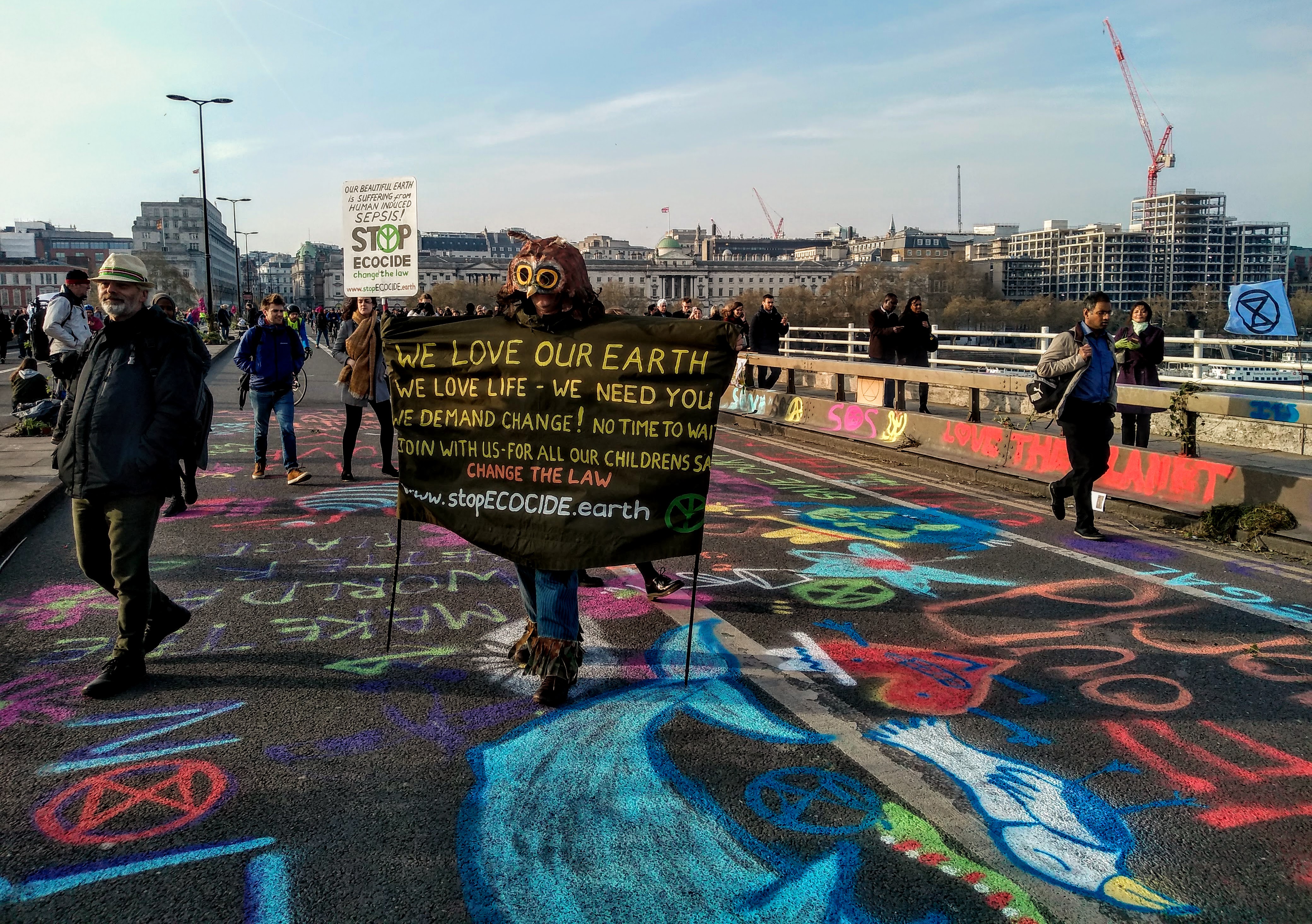
XR activists occupy Waterloo Bridge (April 2019).

The real impact of DPP v Ziegler may be seen in how many arrestees are ultimately charged. According to their own website, previous XR protests have seen approximately 10% of arrestees go on to face charges. It will be interesting to see whether the proportion remains the same for the latest actions. If there is a noticeable decrease, perhaps we may begin to say with more confidence that the Ziegler judgment has had a tangible prospective impact on the ability of individuals to exercise their Convention rights, as well as a retrospective impact on prior convictions. It also remains to be seen whether any previous convictions for offences other than obstruction of a highway may stand to be overturned as a result of the ruling.

To conclude with the question with which this piece opened: is DPP v Ziegler a red herring, a new dawn, or something in between? While the common law is inherently incremental in its approach and it is a rare case indeed which constitutes a total watershed, this one does feel significant. It suggests that the approach of the appellate courts might be converging to some extent with the generally more lenient approach taken by many juries in recent environmental protest cases. It may not lead to a radical shift in policing strategies, but it does suggest that the balance between the rights of individuals to freedom of expression and assembly and the rights of members of the wider community to carry out their business unobstructed may have shifted slightly. But, to echo the apocryphal comments of Zhou Enlai on the French Revolution, perhaps it is simply too early to say.

What I’ve been reading this week…

I do hope you have enjoyed this first post from Green and Pleasant Blog. Next week, Sam Groom will be writing about animal law. In the meantime, I will leave you with what I have been reading this week.

After a summer spent revisiting the works of Charles Dickens, many of which I read and enjoyed as a teenager, I have finally made it back to Bleak House. Not only is it one of Dickens’ longest and most intricately plotted novels, but it is also the most concerned with the legal system. Both the book’s many tangled plot threads and the lives of its vast cast of characters revolve around a particularly intractable case in the Court of Chancery, and Dickens is at his most trenchant in his critique of lawyers and the courts. Bleak House is a deeply impressive novel, with an excellent 2005 mini-series to enjoy afterwards; though perhaps not the perfect Christmas gift for the aspiring lawyer in your life!