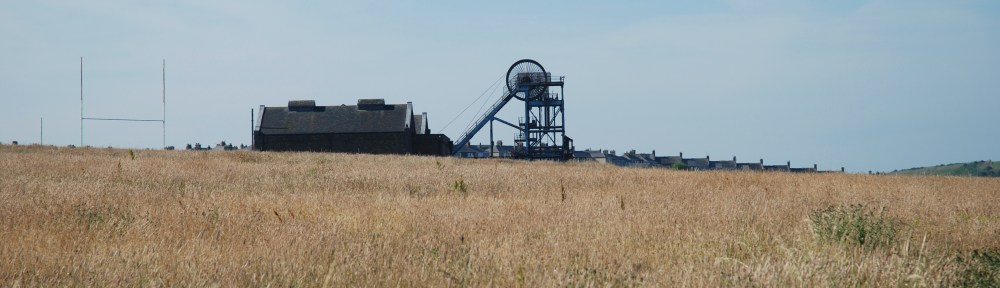
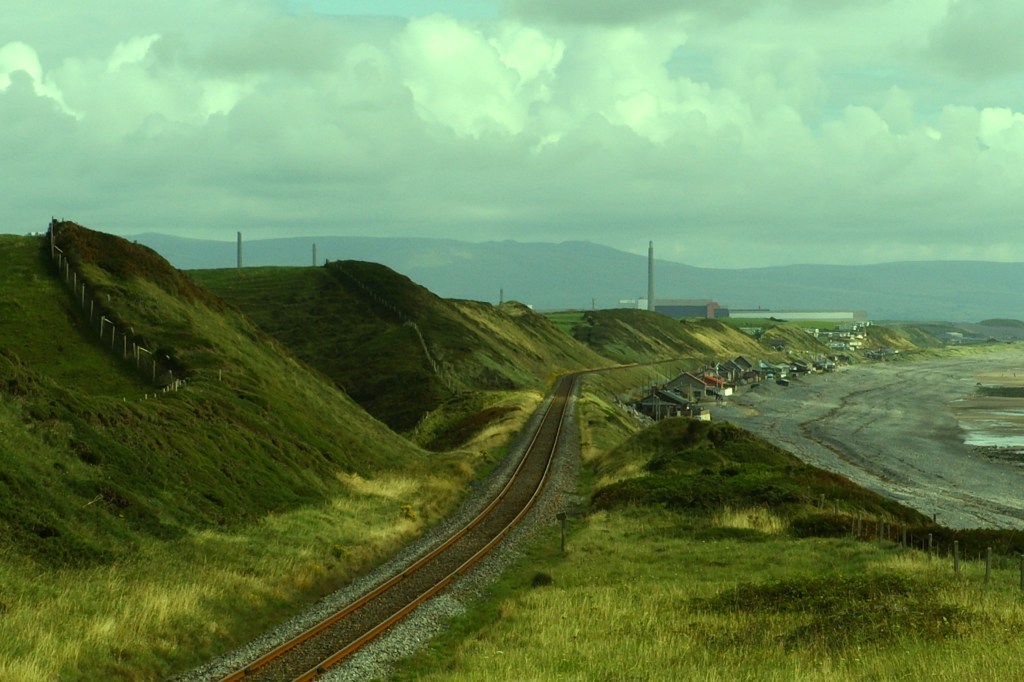
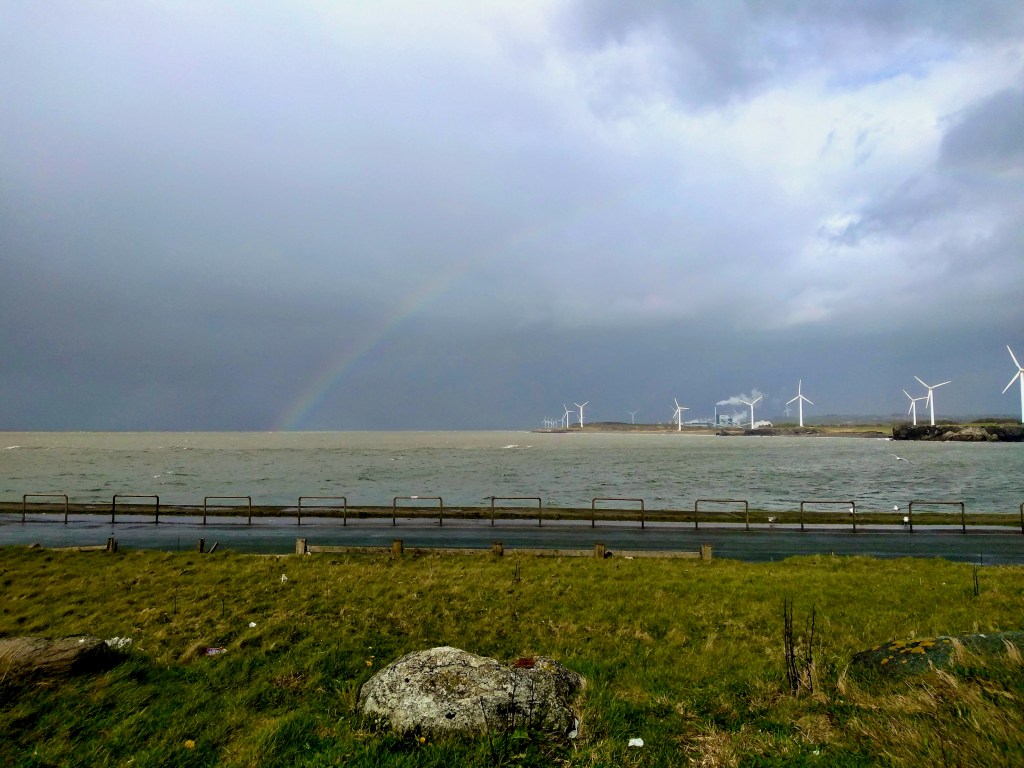
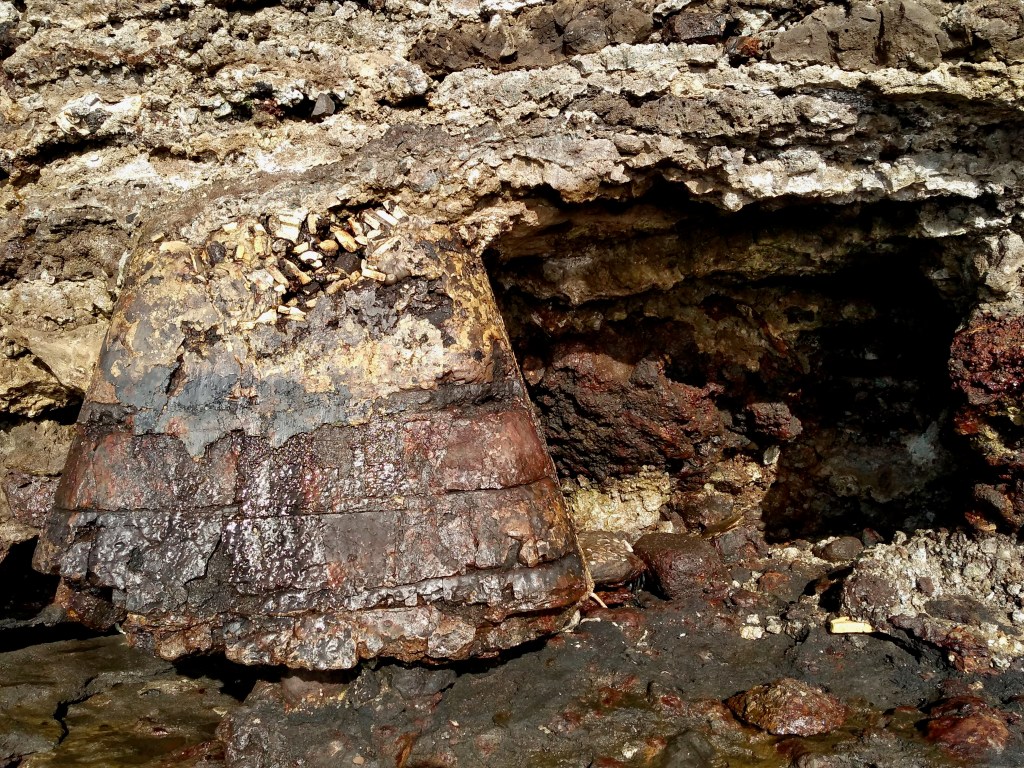
I grew up on the west coast of Cumbria, about two miles north of Sellafield nuclear reprocessing plant and eight miles south of the former mining community and port town of Whitehaven. Further up the coast near Workington, onshore wind turbines overlook the fascinatingly alien landscape of the Workington slag banks, formed from the by-products of pig iron production by the Workington Haematite Iron Company during the second half of the nineteenth and first half of the twentieth century. On a clear day, you can also see the larger offshore turbines of the Robin Rigg windfarm out in the Solway Firth.
Steel production ceased in West Cumbria in 1974 and the county’s last deep coal mine, the Haig Pit at Whitehaven, closed in 1986, but the landscape still provides an insight into the area’s industrial heritage. It also offers a clear indication as to what now sustains the economy of many of the coastal communities between Silloth and Barrow-in-Furness — the energy and especially the nuclear sector. In 2008, a public-private partnership called ‘Britain’s Energy Coast’ (since renamed ‘Building Extraordinary Communities’) launched its masterplan for the West Cumbrian economy, designed to show how it could be put on a sustainable footing by 2027 through investment in new nuclear power plants and renewable energy projects.
But thirteen years later very little of what appeared in the masterplan has come to pass. The area’s economy is still extremely reliant on Sellafield, with research by Oxford Economics in 2017 suggesting that close to 60% of all jobs in the borough of Copeland are in some way dependent on the nuclear site [p. 21], and instead of major new renewable energy schemes generating jobs and economic growth we have the controversial Woodhouse Colliery proposal. If it goes ahead, this colliery near Whitehaven will be the UK’s first new deep coal mine in thirty years.
The company behind the project, West Cumbria Mining (WCM), started developing its plans for the extraction and processing of metallurgical (or coking) coal in 2014. The company claims that the mine would create 530 permanent jobs, of which 80% would go to local people. More controversially, it argues that it would be a ‘net zero’ emissions development, which would achieve compliance with the UK’s legally binding climate commitments via offsetting residual emissions with carbon credits certified by the Gold Standard Foundation.
It is easy to see why the prospect of a major new employer in area, creating hundreds of jobs, might seem appealing. Although wages at Sellafield are high, West Cumbria overall has faced sustained economic decline over several decades. Its working-age population is shrinking. An ever-increasing number of shops in Whitehaven town centre are shuttered up. The area is badly in need of some of the ‘levelling up’ promised by the Government.
In this context, it is perhaps not surprising that the proposal was previously approved by Cumbria County Council on three separate occasions. However, in February this year the council announced that it would be reconsidering the application for a fourth time. A month later, having previously declined to intervene, then Secretary of State for Housing, Communities and Local Government Robert Jenrick announced that he would be calling the application in for a public inquiry after all, citing new recommendations by the Government’s Committee on Climate Change as the rationale for the U-turn.
The inquiry opened on 7 September 2021 and ran for four weeks. The applicant, WCM, and Rule 6 Parties, local campaign group South Lakes Action on Climate Change (SLACC) and Friends of the Earth, appeared and were represented by counsel. Cumbria County Council did not take part in the proceedings, having decided to adopt a neutral stance on the application. Especially keen readers can find the recordings of all the sessions on the Planning Inspectorate YouTube channel.
Before being called in, the proposed development had already been subject to legal challenges on both sides of the debate. A judicial review application against the County Council’s approval of a previous version of the proposal by campaign group Keep Cumbrian Coal in the Hole received permission in February 2020, before proceedings were curtailed when WCM submitted a revised planning application. Earlier this year, the mining company itself announced that it would seek to challenge the County Council’s decision to reconsider the proposal for a fourth time, but the Secretary of State announced a public inquiry before the matter could reach the permission stage.
The entire process to date has served to highlight yet again the extent to which our legal and planning systems struggle to fully assess the climate impacts of proposed developments. Despite the UK’s legally binding obligation under s.1(1) of the Climate Change Act 2008 to reach net zero emissions by 2050 and the obligation on the Secretary of State to set regular carbon budgets (s.4, CCA 2008), the Act is not prescriptive about the actions that the Government or other relevant decision-makers must take to achieve these obligations.
The courts have also tended to be hesitant about pushing back too hard against decisions to approve individual carbon-intensive infrastructure projects. In a recent interview with The Planner magazine, barrister Estelle Dehon, who frequently acts on behalf of environmental campaign groups, suggested that this hesitation might be due in part to a political environment shaped by “many years of politicians… telling the courts ‘If you go too far, you will be knocked back. If you take liberties, we will act to ensure that you can’t do that any more. If you criticise too closely, we’ll clip your wings’.”
Finally, it is difficult to draw precise causal links between specific proposals under challenge and the vast global impact of the climate crisis. Indeed, a recent paper by researchers at the University of Oxford found that the claimants in 73% of cases surveyed across 14 jurisdictions did not even try, failing to cite any peer-reviewed evidence in their submissions. All these factors feed into an environment which makes it hard for legal challenges around climate change to succeed.
In the UK in the last two years, a number of high-profile challenges to emissions-heavy developments have been dismissed. In R (on the application of Finch) v Surrey County Council [2020] EWHC 3566 (Admin), [2021] PTSR 1160, concerning the grant of planning permission for the drilling of four new oil wells in Surrey, the High Court held that a developer’s obligation under the Town and Country Planning (Environmental Impact Assessment) Regulations 2017 to provide an environmental statement describing the likely direct and indirect impacts of a development did not extend to assessing the greenhouse gas emissions resulting from the use of an end-product originating from that development. In R (on the application of ClientEarth) v Secretary of State for Business, Energy and Industrial Strategy [2021] EWCA Civ 43, [2021] PTSR 1400, the Court of Appeal held that then Secretary of State Andrea Leadsom had carried out the balancing exercise under s.104(7) Planning Act 2008 correctly and was entitled to conclude that the benefits of the proposed new gas-fired Drax Power Station outweighed the environmental costs [108–109].
Finally, in R (on the application of Friends of the Earth and others) v Heathrow Airport Ltd [2020] UKSC 52, [2021] PTSR 190, the Supreme Court overturned the judgment of the Court of Appeal that the Government’s Airports National Policy Statement was unlawful on climate change grounds. The Court of Appeal had held that the ANPS failed to satisfy the obligation under s.5(8) of the Planning Act 2008 to “include an explanation of how the policy set out in the statement takes account of Government policy relating to the mitigation of, and adaptation to, climate change”. It defined ‘Government policy’ as being both the UK’s ratification of the Paris Agreement and subsequent statements by ministers Andrea Leadsom and Amber Rudd (Plan B Earth v Secretary of State for Transport [2020] EWCA Civ 214, [2020] PTSR 1446 at [228]). The Supreme Court dismissed these oral statements as being insufficiently clearly formulated to constitute Government policy and held that it would be unreasonable to expect civil servants to “trawl through Hansard and press statements” to identify policies [105]. One might question why the Court did not consider the Paris Agreement itself to constitute Government policy, since ratified international agreements form a clearly defined and readily identifiable list. Given the rather general wording of the agreement, however, it might not have made a difference to the outcome of the case even if the Court had held that it was Government policy to adhere to it.
The cases cited above are not an exhaustive list. Other challenges to the construction of HS2 and the design of the new UK Emissions Trading Scheme have also failed on broadly similar grounds, namely the wide margin of appreciation enjoyed by decision-makers when it comes to translating the UK’s legally binding emissions reduction targets into actual policy. This degree of discretion, coupled with the growing weight of adverse precedent, means that climate campaigners seeking to bring public law challenges against Government policy are facing an uphill battle.
Indeed, the outcomes of these cases beg the question of whether legally binding climate targets are actually enforceable in any meaningful sense. At a national level, the Committee on Climate Change calculates that the UK is not on track to meet its fourth or fifth carbon budgets, and there is an overwhelming scientific consensus that we are headed for catastrophic warming without drastic emissions reductions in the next decade, let alone by 2050. Yet on a case by case basis, it always seems possible for a decision-maker, company or industry body to argue that the emissions from a specific carbon-intensive infrastructure project will be offset by emissions reductions in other sectors of the economy and/or that the socio-economic benefits of a proposal outweigh its negative environmental impacts.
Thus, judicial review challenges brought against the lawfulness of such decisions are likely to keep failing, because of the near impossibility of proving that a particular project in isolation will prevent the UK from meeting its emissions reduction targets. Irrationality challenges seem even less likely to succeed, since the bar for such challenges is set so high (although if one asked an 18-year-old whether they thought it was rational to be constructing new coal mines, oil wells, runways or gas-fired power stations in the 2020s, one suspects they might give a rather different answer from a judge).[1]
Fortunately for campaigners against the Cumbria coal mine, the planning system offers more flexibility about how climate impacts are included in the decision-making process than the legal system does, in part because planning decisions are more explicitly informed by political considerations than legal decisions are. For example, as Estelle Dehon, acting for SLACC, submitted in her closing statement to the inquiry on 1 October 2021, the judgment in Finch v Surrey County Council relates only to whether end-use emissions must be factored in when determining the legality of an Environmental Impact Assessment. It is not authority for the proposition that such emissions cannot be a material planning consideration. In the case of a coal mine, end-use emissions are necessarily fundamental in determining the overall climate impacts of the proposed development.
The inquiry spent its first week dealing with the potential economic benefits of the scheme, its second focussing on the need for coking coal in UK and EU steelmaking, and its third considering the impact of the scheme on carbon-dioxide and methane emissions. The Rule 6 Parties lead a range expert witnesses, whose evidence challenged WCM’s assertion that the project was compatible with the UK’s goal of reaching net zero emissions by 2050. In particular, Professor Stuart Haszeldine of Edinburgh University suggested that the coal was unlikely to be of sufficiently high quality for use in the UK and EU steelmaking markets and the majority was likely to end up being exported further afield, thus negating any net emissions savings on transport, while Professor Paul Ekins of University College London stated that there was no doubt in his mind that the proposals were incompatible with the UK’s emissions targets.
A further blow to the contention that the mine could be rendered net-zero-compatible via carbon offsetting was dealt by the very organisation proposed to supply the carbon credits required to facilitate the offsetting, the Gold Standard Foundation. In a letter to Friends of the Earth and to the inquiry, the Foundation stated that:
“The latest scientific paper from the Intergovernmental Panel on Climate Change on August 9 gave a stark reminder of the pace at which the planet is warming and the unequivocal influence of human activity on this warming, in particular the extraction and use of fossil fuels.
“We note that achievement of the goals of the Paris Agreement would be rendered impossible by the already planned increase in fossil fuels (UN Production Gap Report, 2019), and that the International Energy Agency has clearly stated that further investment in fossil fuels is unnecessary, with achieving global net zero goals instead requiring a rapid reduction in their use.
“It is clear to us, in light of this evidence and reflecting the principles of the mitigation hierarchy, that a new coal mine in 2021 is an activity that must be avoided in the context of the climate emergency.”
Beyond the decision to call the application in, there have also been further signs that the tide of political opinion within the Conservative party might have turned against the project, with Energy Secretary Kwasi Kwarteng stating that there were “very compelling reasons” not to open it and MP for Penrith and the Border, Dr Neil Hudson, dropping his support for the project ahead of COP 26 and urging the Government to invest in clean energy jobs in Cumbria instead. Inspector Stephen Normington indicated that his report should be expected in late December or early January, after which the ultimate decision will rest with the Secretary of State.
Whatever Michael Gove ultimately decides, however, a legal challenge seems fairly likely, at which point all the issues around how our courts deal with climate litigation may come into play once more. All this raises the question — at what point will it become so apparent that we are not on track to meet our net zero emissions targets that the courts will feel justified in declaring new fossil fuel developments to be unlawful? At what point will the effects of the climate crisis become so severe and so unarguable that any decision to approve such a development will be held to be irrational? How many more canaries will we allow to die before we finally decide to close the coal mine?
[1] For discussion of irrationality in this context see R. (on the application of Finch) v Surrey County Council [2020] EWHC 3566 (Admin) ,[2021] PTSR 1160, [127]; R (on the application of Friends of the Earth and others) v Heathrow Airport Ltd [2020] UKSC 52, [2021] PTSR 190, [125-129].
What I have been listening to this week…
A couple of weeks ago, some eighteen months after the gig was initially scheduled to take place, I was finally lucky enough to see Nick Cave in concert at the Royal Albert Hall. I have been a fan of his music since I was a child and so seeing him live was an absolute privilege and delight. Almost the entire setlist was from two albums: 2019’s majestic, if sometimes harrowing, ‘Ghosteen’ — a meditation on love and loss written in the aftermath of the death of Cave’s teenage son in 2015 — and 2020’s ‘Carnage’, a wild and surreal lockdown album composed over just three days alongside longtime collaborator Warren Ellis. Both are exceptional in their own way and I have been listening to them and the rest of the Bad Seeds back catalogue a lot since the gig.
On a slightly more sedate note, my choir is currently rehearsing for a performance of Brahms’ Requiem in December, so I have been reacquainting myself with one of my absolute favourite choral works, and trying not to get too out of breath singing the fugue in movement six!
 Green and Pleasant Blog
Pingback: Split decision in Mozambique gas project challenge | Green and Pleasant Blog